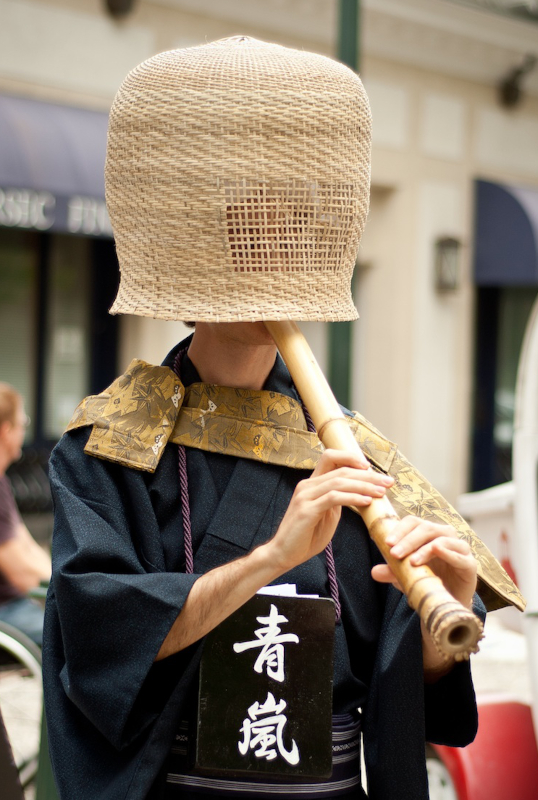
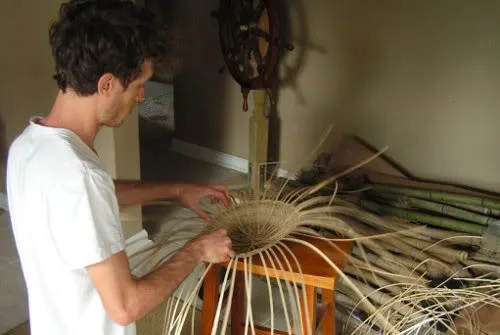

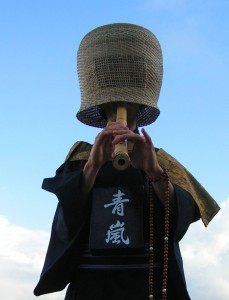
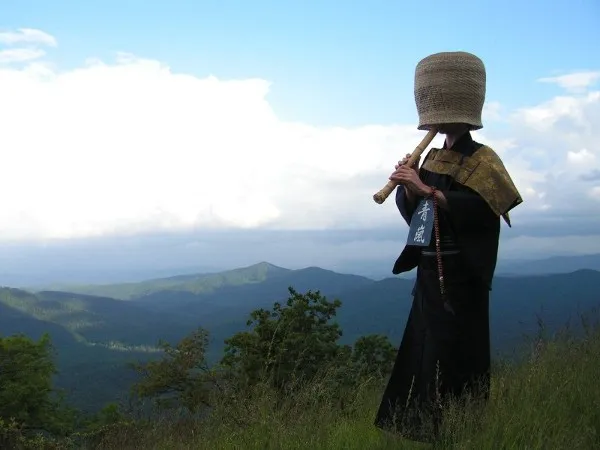
Above: practicing formal shakuhachi Takuhatsu Komuso alms begging and weaving my Tengai hat
A Hidden Komuso Practice Comes to Light
From roughly 2012 to 2020, I practiced Komuso shakuhachi Takuhatsu alms begging in the streets of America. I tried to keep my practice itself far from the internet’s gaze. That’s why I’ve only got one picture of me in those moments, as seen above (the other photos are not of me practicing alms begging). A photographer from a news publication actually snapped that photo without my consent. I asked the publication to remove it from their website out of respect for my religious practice. However, they refused! Now, a decade later, and I must admit that I’m truly glad to have at least one photo of me out there, a beautiful photograph too!
Weaving a Tengai, Weaving a Path
To begin my practice, I patiently wove my own Tengai Komuso hat. From what I could gather, I might actually be the first non-Japanese person to weave one. This isn’t too surprising though because it’s a highly rare object to weave. At the start of the 2020 COVID outbreak I actually sold it for charity. One day I might weave another, we’ll see…
The Heart of Alms Begging
Uchiyama Kosho Roshi (1912-1998) wrote that, “The attitude of one on takuhatsu must be one of equanimity, whether no donation is received or a large one is received. In fact, the attitude of the mendicant on takuhatsu is one of giving an opportunity to people to materially support a life of one dedicated to zazen and the teaching of the Buddhadharma.”
His words capture the true spirit of this practice, at least in my experience as a Komuso. Specifically, people often feel good when they can show appreciation for another person’s pratice.
As for my own experiences, I hope sharing a little bit here offers value to others. A lot of it was about how I reacted or didn’t react to things, both from living creatures and the elements, from ‘positive’ moments to ‘negative’ ones.
Embodying the Komuso
My intention was never to present “myself.” Instead, I aimed to embody the act of playing shakuhachi as a Komuso in the streets. My hope was that “my identity” wouldn’t and shouldn’t matter. I wanted the shakuhachi and its rich history to take center stage.
However, when you don a Tengai and play shakuhachi in public, especially in a society that barely recognizes, let alone respects the Komuso image, interesting things happen. Many interactions were beautiful. I connected with others, the environment, this experience (no separation). Yet, there were also many concerning situations. You could say that doing this in America is asking for trouble and you’d be right!
Lessons from the Streets
As a Komuso people often invaded my personal space, period. Some touched my fingers, clothing, and even my shakuhachi. Others peered up under the Tengai. They’d talk about “me” as if I wasn’t there. Sometimes I faced threats and was even physically attacked. Other times I was praised, even borderline worshipped. I suspect mental health issues were at play in many of these extreme encounters.
For some of us this all sounds far too familiar, no Komuso practice required! Unfortunately, dehumanization is a daily reality for many people in the form of bigotry and its cousin idealization. With or without a Tengai, we always encounter people projecting their ideas onto us. In my experience, I could only hope to become a “master of my self”. This meant how I reacted, of course, but even more so how I didn’t react to the “fight, flight, and fawn response”. I had to face adrenaline, anxiety, fear, euphoria, pain, the whole spectrum.
Tips for Komuso Street Practice
I’ve got some tips for anyone thinking about playing shakuhachi in the streets. First, always keep your back to a wall or something so people can’t come up behind you BUT be sure nothing can fall or be dropped on you from above. Similarly, avoid corners of buildings/structures. Lastly, giving some of your alms money to an angry or otherwise disturbed person can defuse a situation fast. Most importantly, unlike me, try not to go out alone!
Unveiling the Komuso Tengai: Truths and Myths
To wrap things up, let’s bust a few myths! Tengai offer no protection from rain or wind, none at all (I even constructed mine more tightly and thoroughly woven than most). Depending on the design, they hardly shield you from the sun either. And they make for a poor “disguise”! As I related earlier, anyone bold enough to simply bend down and look up under the Tengai will easily see the face of the person wearing it. So much for the prevailing “Komuso spy’ mythos… It’s hilarious how so many of these myths melt away like mist when touched by the light of actual experience.
Despite the more dangerous situations, the most vivid memory I have of my time out there is of a little kid who gave me a flower. Josen

Comments
One response to “Retrospective on My Komuso Practice in the Streets of America”
Wonderful.